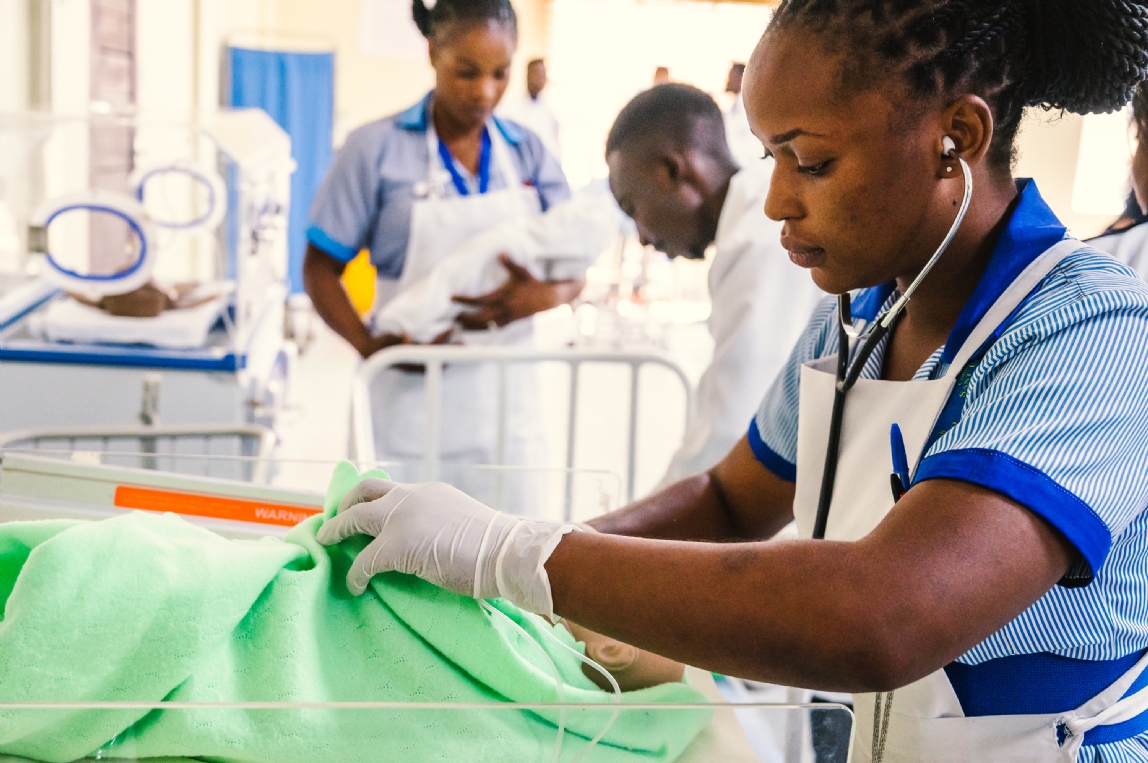
In many regions of Zambia, there is a lack of qualified nursing staff. Health stations are under heavy strain and access to a sound education is limited for many young people.
At the same time, the demand for well-trained nursing staff is high, especially in rural areas.
The “Scaling Up Decentralized Education for Nurses (SUDEN)” project addresses this initial situation. It is financially supported by the LED and other partners and implemented together with the Zambian Ministry of Health. The aim is to decentralize practical nursing training and anchor it nationwide.
The training model is based on not only providing nursing training at a few large hospitals, but systematically integrating it into hospitals and health stations throughout the country. Students complete their training in a rotation system between colleges, hospitals and rural health stations. Doctors and nurses at the participating locations are specifically trained as mentors.
In addition, skills labs are set up and used to train practical skills in a realistic manner. In this way, a nationwide network of training locations is gradually being created, which at the same time strengthens local healthcare provision.
Together with the Ministry of Health, SolidarMed is introducing this decentralized training model in all provinces of Zambia.
The project contributes to improving the quality of education and increases the number of students who successfully complete their education. At the same time, the proportion of nurses who work in rural areas after graduation is increasing. In this way, SUDEN is helping to strengthen the healthcare system and improve basic medical care for the population.